Piran: a Venetian town on a cape between the sea and the salt pans
Piran stands on a narrow cape that juts into the sea, so the town ends where the water begins. The streets are narrow and shady, the houses squeezed one against another, and at the top opens a square that was once a harbour. It is precisely this density that makes Piran feel different from the other seaside places in the country.
The old town is closed to traffic, so a visit means walking. The distances are short, as from the car park to Tartini Square and on to the tip of the cape you walk only a few minutes. You can get to know the town in a single afternoon, though a reason for a longer stop is quickly found.
Tartini Square and the heart of the town
Tartini Square was, until the end of the nineteenth century, an inner harbour, which was then filled in and paved. Today it is elliptical, white and open, surrounded by a Venetian palace and the town hall, with a statue of the violinist Giuseppe Tartini in the centre, who was born in Piran in 1692.
Around the square begins a network of alleys leading towards the sea and up towards the walls. In the old town centre it does not pay to look for shortcuts, because it is precisely the side lanes that visitors remember most.
The Church of St George and the town walls
Above the town stands the Church of St George with a bell tower that is a smaller version of the one on St Mark's Square in Venice. The platform in front of the church is a viewpoint and freely accessible, so climb up to it before descending back among the streets.
Higher up the slope rise the town walls with towers, preserved in several belts. The climb up to them is short and steep, and from the top, in clear weather, you can see all the way to the Alps.
The sea, swimming and Fiesa
Swimming in Piran takes place at laid-out bathing areas along the coast, where the entries are arranged with steps and platforms rather than a sandy beach. For a more relaxed day it pays to walk the coastal path to Fiesa bay, which begins beyond the town bathing area.
By Fiesa there are two small lakes, separated from the sea by a sandy bank, which is a rarity for the Slovenian coast. Walk the path from the town in the evening too, because it is in shade most of the time.
The salt pans and the hinterland
A few kilometres further south lie The Sečovlje Salt Pans, a landscape of shallow basins, channels and embankments, where salt is still produced in the traditional way. The landscape park is at the same time a well-known bird-watching area, as you can watch migratory birds right from the embankments between the basins.
The hinterland above the town is Istrian: olive groves, vineyards and villages on the ridges. If you have half a day, you can drive or cycle up to the panoramic villages above the bay and return towards the sea by another route.
What to do in Piran?
The basis of a visit is walking, as the square, the streets, the walls and the coastal path to Fiesa link into a single loop. In summer the programme expands to swimming, boat trips and guided tours of the town that explain the Venetian background of its architecture.
Out of season the town is at its most pleasant, because the streets are empty and the sea is still there. Check experiences in Piran and choose the one that suits the season of your visit.
Piran with children
With children, the combination of short distances and water works well. A walk to the tip of the cape, where the sea opens on three sides, and a swim at the bathing area can fill a whole morning, without any transport in between.
For the afternoon choose the aquarium by the mandrač, a boat trip, or the salt pans, where children can walk along the embankments between the basins. The narrow, stepped streets are not kind to a pushchair, so a baby carrier is often more practical.
Piran for two
For a quieter visit, choose the early morning or the time after dinner, when the day visitors withdraw. A walk around the cape at sunset is the best-known choice, and yet it is still the best.
If you want a view from above, climb up to the Church of St George or onto the walls, where the town looks like a whole rather than a string of alleys.
What and where to eat in Piran?
The cuisine is Istrian and maritime: fish, shellfish, pasta with truffles, olive oil from the hinterland and refošk. In restaurants by the mandrač and on the square the offer is most concentrated, while the quieter eateries are in the side streets.
The salt pans also produce Piran salt and fleur de sel, which you can buy in the town and take home as a local gift.
Where to stay in Piran?
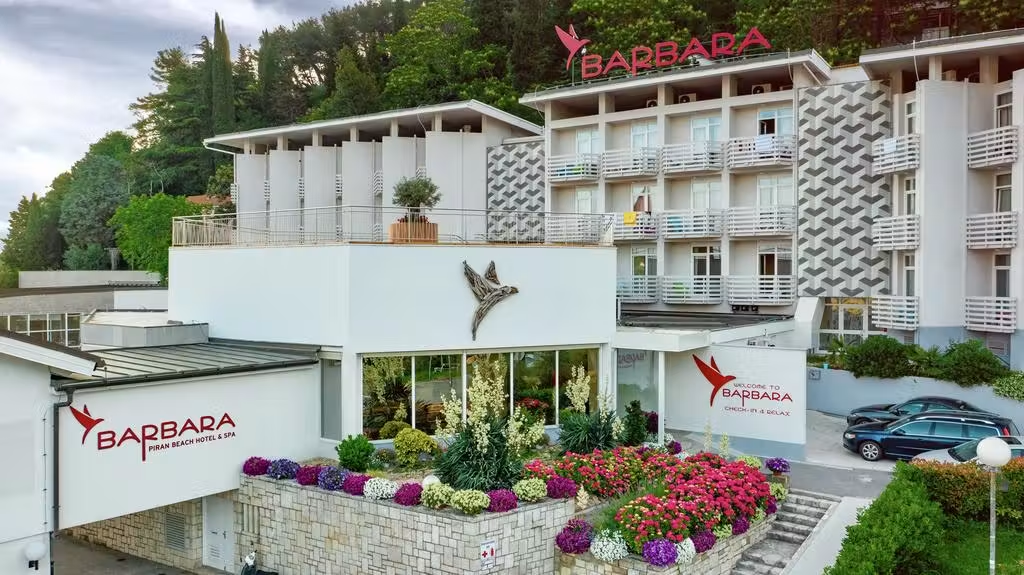
The offer in the town itself is modest because of the limited space, so arrange your accommodation in advance, especially for summer weekends. Available are hotels and other accommodation in the old town and just above it.
If you are looking for more choice, look at the neighbouring Portorož, which is a good three kilometres from Piran and has most of the hotel offer on this part of the coast. Between the two places there is also a laid-out coastal path, so you do not need a car for a day visit to the town.
Where to go on a trip from Piran?
The nearest two are Izola with a fishing flavour and Koper with the largest old core on the coast, both within half an hour. To the south are the salt pans and beyond them the Istrian hinterland.
For a whole day you can move to the interior towards the Karst, where the sea gives way to a stony plateau, wine and the underground. The distances are short, so combining the sea and the Karst in a single day is entirely feasible.