On Castle Hill above the old town core stands Ljubljana Castle, one of the most recognisable sights of the Slovenian capital. Its appearance has changed over the centuries, since the castle was a defensive stronghold, the residence of the provincial governors, a military warehouse, barracks, a hospital, a penitentiary and a residential complex. Today it is a historical sight, a cultural centre and a popular viewpoint.
Castle Hill was already settled in prehistory, and the oldest known settlement dates to the end of the second millennium BC. Because of its commanding and naturally protected position, it was suitable for controlling the Ljubljana Basin and the routes along the Ljubljanica River.
The first written mention of Ljubljana Castle can, on the basis of a preserved document, be placed in the period between 1112 and 1125. In 1144 Ljubljana is mentioned under the historical German form of the name, Laibach, and two years later the Slovene-Romance form Luwigana was recorded as well. The spelling Laybach appears in the sources later but is not connected with the first mention of the town in 1144.
In the early Middle Ages a wooden fort stood on Castle Hill, later replaced by a masonry castle. In the 13th century the castle was connected with the Spanheim family, and then it changed owners several times. In 1335 Carniola came under the rule of the Habsburgs.
Because of the danger of Ottoman raids, in the 15th century the older Spanheim fortress was almost entirely demolished and a new fortification built. It was adapted for defence with new firearms and given a mighty wall, towers and the Pentagonal Tower with a drawbridge. The Chapel of St George, consecrated in 1489, also dates from this period.
Most of the buildings along the inner side of the castle wall were built in the 16th and 17th centuries. They housed rooms for the provincial governor and other castle users, while the central courtyard also served for the gathering of the provincial noble army.
In the middle of the 17th century Ljubljana Castle began to lose its defensive and residential role. A military warehouse was set up in it, and because of the stores of gunpowder the castle posed a danger, during storms and fires, to the town below it as well. During Napoleon's Illyrian Provinces the castle housed barracks and a military hospital.
In the 19th century the castle premises were converted into a penitentiary, which operated, with an interruption, right up to the Ljubljana earthquake of 1895. During the First World War political prisoners were also held at the castle. Among them, in 1914, was the Slovenian writer Ivan Cankar. Later the castle also served as a quarantine station for prisoners of war and as a prison during the Second World War.
Between 1845 and 1848 the older wooden viewing tower was replaced by a new masonry tower with a clock. It housed the flat of the fire watchman, who warned of fires in the town with cannon shots. In the 20th century the tower was renovated and raised, and today it is one of the most visited viewpoints in Ljubljana.
The Viewing Tower should not be confused with the Pipers' Tower. This was a separate building that stood in front of today's Viewing Tower. It is first mentioned in 1544. On its wooden gallery the town musicians played wind instruments every morning, announced important events and warned the inhabitants of dangers and fires. The tower was heavily damaged during French rule, and today's Viewing Tower was later built beside it.
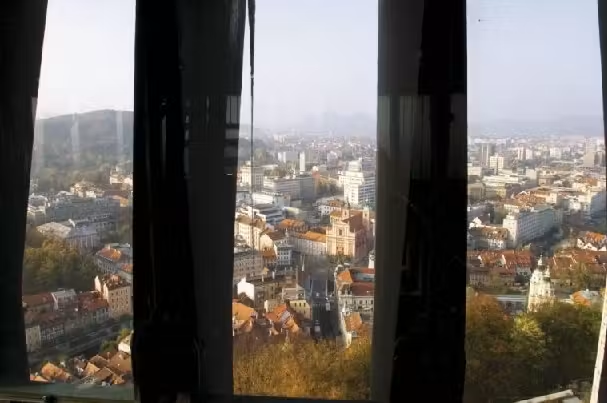
From the top of the Viewing Tower a view opens onto the old town core, the Ljubljana Basin and the surrounding hills. In clear weather the Kamnik-Savinja Alps are clearly visible, and the view also reaches towards other parts of the Slovenian mountain world. Winding metal stairs lead to the top of the tower.
The best times for photography are early morning and late afternoon, when the light is softer. A fine view is also offered by the castle walls, the Šance and individual points on the walking paths across Castle Hill.
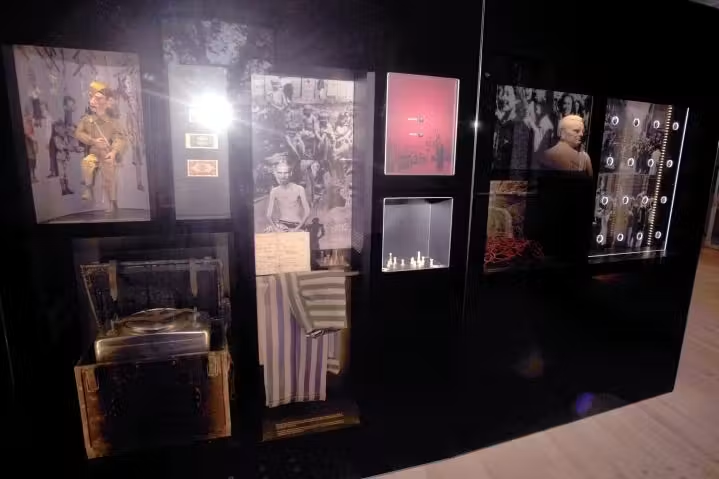
Visitors can see the permanent exhibition Slovenian History, the Puppet Museum, the former Penitentiary, the Castle Weapons exhibition and the Chapel of St George. In the Virtual Castle the history of the castle complex is presented with a projection, while various spatial and exhibition contents are on display in the Casemates.
A special feature of the Chapel of St George is the ceiling, painted in 1747 with the coats of arms of the Carniolan provincial governors. In the Erasmus Tower, which is said to have once served as a noble prison, the coats of arms of prisoners carved into the walls are still visible.
An audio guide is available for independent exploration, and visitors can also choose the guided tour Time Machine. The castle also offers family experiences, occasional exhibitions, a shop, a café, a wine bar and a catering offer.
Throughout the year Ljubljana Castle hosts concerts, exhibitions, theatre performances, film screenings, lectures and other cultural events. In summer the open-air events are especially popular, when the castle courtyard becomes a venue above the city. On certain dates the Castle Pipers also perform, reviving a centuries-old musical tradition.
The wooded paths on Castle Hill allow a quick escape from the bustle of the city. Several footpaths lead to the castle from the old town core, among others from the area of Vodnik, Stari and Mestni Square. You can continue the walk towards the Šance, redesigned in the 20th century by the architect Jože Plečnik, or towards the Castle Vineyard on the southern slope of the hill.
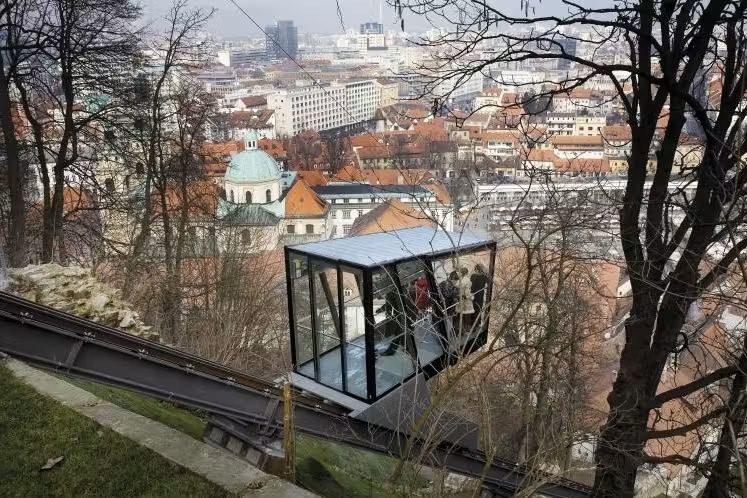
The fastest access is by the funicular, whose lower station is on Krek Square opposite the central Ljubljana market. The ride is short and already offers a view of the city during the ascent. You can also reach the castle on foot, by bicycle or by tourist train.
The walk up from the old town core takes roughly 10 to 20 minutes, depending on the chosen path and walking speed. Some paths are fairly steep, so comfortable footwear is recommended.
For a quieter visit, come in the morning or late in the afternoon. In summer the castle is busiest in the middle of the day and during larger events. In spring and autumn a walk on Castle Hill is more pleasant thanks to the lower temperatures, while in winter you can experience the castle and its exhibitions with fewer visitors.
Ljubljana Castle is open every day of the year, but the opening hours of the castle, the exhibitions and the funicular vary depending on the part of the year. Before your arrival, check the current opening hours, the schedule of events and the accessibility of individual contents on the official Ljubljana Castle website.