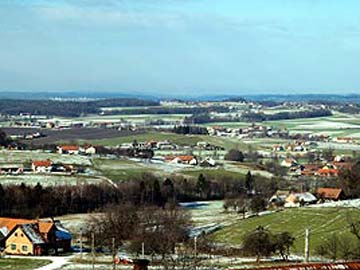
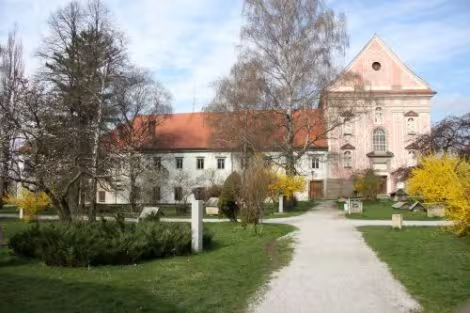
You begin the route at Terme Ptuj and ride to the main crossroads before the Ptuj bridge over the Drava and there you turn right twice. You are already on Rogaška cesta and after a few hundred metres on the right-hand side you see the little church of St Roch. After it you turn left and continue to the railway line, head right and beside it continue the route straight on across the crossing at the barriers and about a kilometre towards the underpass with the trunk road.
You turn right towards Hajdina, which is adorned by the church of St Martin. 500 m beyond the church you turn left between the houses onto a gravel field track, which will bring you to Njiverce pri Kidričevem. Through the settlement of Kidričevo you ride past the Mercator shop and the summer lido to the manor, where you turn left towards Strnišče, through the settlement and left past the red mud dump along the asphalt road to Župečja vas.
You continue the route through Župečja vas, Lovrenc na Dravskem polju and Podlože, where you turn right towards Sestrže and, at the foot of Savinsko, leave the flat Drava plain.
Over the demanding climb to Gaj and the pleasant descent to Mostečno you will have to make an effort to cycle down into the valley of the Ložnica and the Dravinja.
The next settlement is Pečke, and if you stray a little from the route and ride straight on in Pečke, you can see Štatenberg manor, a popular excursion spot.
To continue along the Dravinja cycling route you return to Pečke and turn right towards Majšperk. Cycling through the valley of the river Dravinja offers you the sight of many cultural and historical monuments. The first is the church of St Nicholas in Majšperk. To see the others you will have to climb.
In Stanečka vas, for example, you turn left and climb 100 metres of altitude to become one of the 60 thousand visitors who each year see the church of Mary on Ptujska Gora.
After returning to the Dravinja valley there follow the settlements of Slape and Doklece, from where many only look at Janški Vrh on the right, while few manage to cycle up to the church of St John, which lies 200 m above the Dravinja valley. The two-kilometre route to the top is good training before the ascent of Vršič, while to "ordinary" day-trippers we recommend a combination with walking.
When you are back beside the Dravinja you ride through the settlements of Bolečka vas, Zg. Pristava and Popovci all the way to Jurovci, where you carefully cross the very busy main road Maribor – Gruškovje. After three km riding towards Ptuj we turn to Turnišče castle, past it across the Studenčnica and a kilometre on gravel to the Pinčar mill and past the treatment plant to the Ptuj thermal spa.
Ptuj is a town and the centre of the urban municipality of Ptuj. It is the oldest documented town in Slovenia. It has a rich history and cultural heritage. The Town Tower, which dates from 1976, is the town's most imposing architecture. The town hall is the most distinguished house on Mestni trg; today it is the seat of the Urban Municipality of Ptuj. In the middle of the square stands the Florjan monument, which the inhabitants erected in the y 1745. In the town there is also the 5 m high Orpheus monument, which is the largest that has been discovered in the Roman province of Upper Pannonia. Besides these sights it is worth seeing the Dominican and the Minorite monastery, the Church of St George, Ptujska Gora,….
Hajdina is adorned by two churches. In Spodnja Hajdina there is the Church of St Roch , which is said to have been built in the y. 1650, at the end of the cholera epidemic, but about the origin of the hill on which it stands several interesting stories circulate. According to one of them the Hunnic king Attila is said to have been buried here. At Sp. Hajdina the oldest Mithraic shrine in the Danubian Roman provinces was discovered. At Zgornja Hajdina there is the church of St Martin, built in the y.1874, and it is already the third on this spot. The most remarkable part of the church is the old Gothic choir.
As you ride through the village of Pečke, and if you turn a little offthe route, the road will bring you to Štatenberg Castle, which the counts Attems had built between 1720 and 1740. It houses an ethnological collection and a restaurant, and beside the manor a lavish English park with walking paths and ponds has been preserved.
The Church of St Nicholas in Majšperk dates from 1639, and in the village there is also a monument to the victims of the Second World War. At Janški Vrh there is the branch church of St John the Baptist from the 15th c., and the column shrine dates from 1687. At Ptujska Gora stands the famous pilgrimage church of St Mary from the end of the 14th century. It is one of the most beautiful far and wide, and in it there are works by many well-known painters and sculptors. Nearby, in the cemetery, is the church of St Leonard, first mentioned in 1567.
A little beyond Tržec, in a disused gravel pit, there is a pond intended for sporting activities, and before the end of the route Turnišče Manor and the Pinčar Mill, which is no longer in operation.
In Turnišče there is the well-known Church of the Virgin Mary Under the Grove. The church is exceptionally rich in frescoes created in the 14th century, whose master was Janez Aquila. Every 15 August the Great Parish Feast is held in honour of the Holy Virgin Mary beneath the grove. On that day around 10,000 people gather. It is built in two styles, Gothic and Romanesque, which gives it particular historical value as well. In the middle of Turnišče stands the Chapel of St Anthony of Padua from the 18th century and numerous plague columns. You can also visit The Shoemaking Museum, which was established in 1979, the Kovač Homestead, which combines an ethnographic and a historical insight into their past.
The route is, with the exception of the climb to Gaj, flat, and because of its length it deserves two stars. The difficulty increases considerably with a visit to Ptujska Gora and Janški Vrh. The roads are well maintained and suitable for all types of bicycle, and with a little resourcefulness the two gravel sections can be avoided.